
Stylized Character Creation with AI
Research Team
Spencer Idenouye
Mike Darmitz
Mohammad Moussa
Valentina Bachkarova
Emerson Chan
Partners & Funders
Big Jump Entertainment Inc.
NRC IRAP
CTO
Impact
- AI-Image Generation
- Rapid Prototyping
- Workflow Optimization
Hybrid LoRA Generative Pipeline
This project explored the feasibility of a scalable, ethical, and on premises AI-assisted production pipeline for episodic content development, with a focus on accelerating the creation of stylized 2D and 3D character assets.
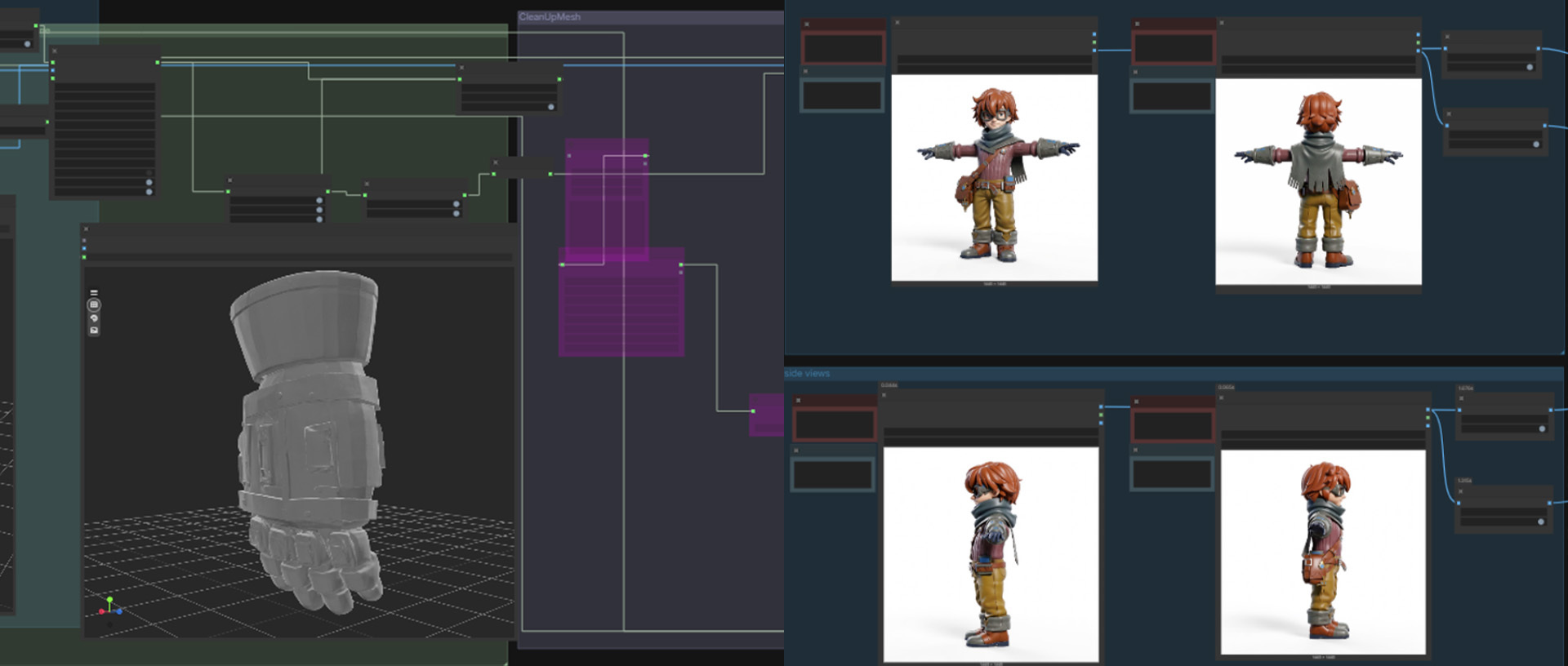
Across the project, research and testing examined current open-source image generation models, adaptable customization methods, multi-view image generation approaches, image-to-3D conversion workflows, and downstream asset refinement for animation use. The work demonstrated that AI tools can meaningfully support early-stage asset development and prototyping, while also highlighting the importance of pipeline design, validation, and production context in determining where these technologies provide the most practical value. A key area of investigation was the integration of these tools within a secure, production-aware environment, emphasizing artists-in-the-loop workflows, data control, and alignment with ethical dataset practices. Overall, the initiative established a strong high-level framework for evaluating how AI-enabled tools can be integrated into future content pipelines in a way that is flexible, production-aware, and aligned with emerging creative and operational needs.
The project progressed through a series of connected milestones that collectively established and tested a high level AI-assisted asset creation pipeline for episodic content production. Milestone 1 focused on evaluating current open source image generation base models and establishing the groundwork for LoRA training workflows. This work produced a practical understanding of model selection, dataset preparation, training setup, and style or character-specific customization, with the benefit of clarifying how image generation tools could be adapted for production-oriented use cases. Milestone 2 examined multi-view image generation workflows, identifying approaches for producing consistent multi-angle character imagery that could support later reconstruction steps. This milestone provided the benefit of clarifying where current multi-view workflows are useful, while also revealing limitations in fully relying on them for direct mesh generation. Milestone 3 advanced the work into image-to-3D conversion, resulting in a tested workflow for generating initial 3D character models from image-based inputs. This milestone demonstrated the practical potential of AI-assisted 3D asset generation as an early-stage prototyping and content development tool. The remaining milestones focused on mesh refinement, validation, assembly, and rigging, producing a cleaned and optimized character asset with improved topology, UVs, preserved texture detail, normalized scale, and a functional rig suitable for animation testing in Unreal Engine. The benefit was the validation of an end-to-end workflow for transforming raw AI-generated geometry into a structured, animation-ready asset.
Overall, the project’s outcomes demonstrated the viability of AI-assisted methods for accelerating asset development, improving rapid prototyping capacity, and informing future production pipeline design, while also identifying important technical, creative, and operational considerations for further research and implementation.